 EU
[spacer height=”20px”]
The far-right political parties are anything but new to Europe. We’ve known them since the period after World War I and till this day their ideology continues to exist. But what happens when they start to gain popularity through-out the whole continent and start to win more and more votes in elections?
[multilanguage_switcher]
[spacer height=”30px”]
“Swedish Democrats”, “National Front” in France, “FPÖ” in Austria and “Fidesz” in Hungary – these are some of the parties forming the new political landscape of Europe. Thanks to the economic instability, the growing terrorism and the migration crisis, the far-right movements gain more and more supporters.
Their tactics are similar. One of the methods they use is the “us against them”. With this idea they reject the multicultural society, the globalization and the Europeanisation and fight anyone who allows foreign influence into the country. Using the treat for the “national identity” their message manages to reach thousands of people, who under different circumstances wouldn’t support them.
For the far-right parties “them” is the different culture, ethnicity or religion that tries to denationalize their country. Therefor one of the biggest battles the radical parties lead is against the mas-migration. Enjoying the surge of support on the back of the continent’s migrant crisis, the parties turn the fear and tension into a fuel for their political campaigns.
[spacer height=”50px”]
“The National Front is the only party that defends the authentic French country and fight for the preservation of the French traditions” – Marine Le Pen
[spacer height=”50px”]
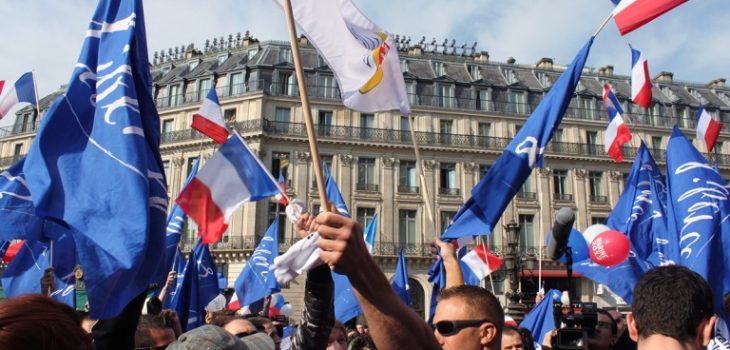
During the first round of regional elections in France, the leader of the extreme-right party “National Front” – Marine Le Pen managed to collect 30 % of the votes – an unexpected victory shooting her temporary on the top with two won regions – Nord-Pas-de-Calais-Picardie and Provence-Alpes-Cote d’Azur.
But what really guaranteed Le Pen’s success was the series of attacks on Nov.13. She saw the assaults as an opportunity to promote her ideas of protectionism, Euroscepticism and anti-Islam. Using the fear, she managed to convince the French that the National Front is the nation’s savior, rescuing the country from the chaos and preserving the national identity.
In her campaing, Le Pen criticized openly the policy of the French government for dealing with the migration crisis, increasing the tension furthermore. Doing so the NF won 30 % of the votes of people between 18 and 35 on the first round and of people living in the affected by the migration wave areas.
Despite its good start, the National Front lost on the second tour to Nicolas Sarkozy’s party.
The battle may be lost but the war is just starting. Marine Le Pen gained just enough popularity in and outside of France to improve her chances to run in the presidential election in the spring of 2017.
[spacer height=”50px”]
“The European Union should not accept people that have a fundamentally different culture and religion” – Viktor Orban
[spacer height=”50px”]
One of the most important leaders of the far-right movements in whole Europe and the politician sharing the most extreme views is the prime minister of Hungary – Viktor Orban. With his regime of extreme xenophobia and hostility towards the refugees he not only mocks the Europeans ideals but encourages other eastern European governments to follow his lead.
In his second consecutive term, Orban keeps shocking the world with his harsh actions and aggressive measures. In 2015 Hungary built a fence on its border with Serbia long 175 km to stop the crossing of migrants.
The Prime Minister also rejected the EU proposal for refugee quotas. His Party- Fidesz continues to be supported by 82 % of the Hungarian population.
Playing on the political scene in Hungary there is another party – Jobbik. This is the second most supported party in the country with growing success.
[spacer height=”20px”]
Another absolute surprise was the progress of the far-right in Sweden. Considered as one of the most social countries that accepted nearly 160,000 refugees for the last year, Sweden also had a harsh change in the public’s opinion.
During the elections in September 2014 the nationalist party – Swedish Democrats won 13 % of the people’s votes, turning into the third largest party in the country.
The SD promotes “preservation of the national identity”. Their ideology is strongly against the multiculturalism which they believe is threatening the Swedish culture and society. The party rejects the integration of Muslims, again fearing a denationalization. The Swedish Democrats disapprove of the government’s policy for dealing with refugees, joining the EU and The Economic and Monetary Union.
It is precisely those ideas that made Swedish turn their back on the socialist parties and support Jimmie Åkesson.
The messages the party sends out to the people often creates tension in the country and leads to aggression. In October of 2015 three refugee camps in Gothenburg were set on fire and a day earlier – a school for the kids of migrant families.
[spacer height=”20px”]
In a time of a strong crisis in the European Union, leading a policy of protectionism leaves serious damages both in economic and in humanitarian view. Every country that tries to isolate itself creates a chain reaction throughout the whole continent and threatens the whole and the values of the European Union.
In late January the Prime Ministers of Austria, Croatia, Slovenia, Serbia, Albany, Bulgaria and Bosnia and Hercegovina decided to establish full border control. Croatia who is located on the end of the “Balkans route” announced to limit the number of entering migrants to 580 people per day.
Far-right parties also exists in Bulgaria. Created in 2005, “Ataka” is one of the most scandalous parties on the political scene. Lead by Volen Siderov, it strands strictly against the Islam, Turkish language in the media and Bulgaria’s membership in NATO. Today “Ataka” owns its newspaper, a TV channel and it is parliamentary represented.
[spacer height=”30px”]
A key role in this political situation in Europe also have the economic factors, especially in countries of Central and Eastern Europe.
Isn’t it natural for the people to fear for the future of their countries? The truth is that in this period of economic instability, high unemployment rates and crisis, accepting migrants and leading a generous and open policy could be fatal for the social systems of counties like Greece, Bulgaria and Hungary.
Let’s remember that it was precisely in times of an economic weakness the National socialist German Party managed to win its supporters and to climb up to the top of the power.
With promises of regaining economic supremacy in Europe and protection of the German worker, Adolf Hitler won a tremendous popularity and the support of the nation.
This is why the choice of the ordinary French or Hungarian citizen is not unfounded. The engine of the far- right political parties is precisely that – the fear, the tension of the growing terrorism and the treats for the integrity of the EU. Voting for those parties, isn’t that an instinct of self-preservation?
[spacer height=”35px”]
Right now is the time that the European Union has to play its key role. After the heavy Greek economic crisis, the incapability to lead a united policy against the migration wave, growing terrorism and the upcoming referendum for Brexit, EU risks to continue to lose support from its citizens. Therefore the need of a policy that respects the specific interest of each country and strengthens the trust in the European institutions is crucial. This is the only way Europe can emerge from this crisis stronger and preserve the ideals on which it’s build.
[spacer height=”40px”]
-
Viktoria Buchkova
[spacer height=”50px”]